How to Find an AI Consultant Who Actually Understands Business ROI
Plenty of people can build an AI workflow. Far fewer can explain what it will do for your business in numbers you can defend six months later. Here is how to filter for the consultants who speak in dollars, not just models.
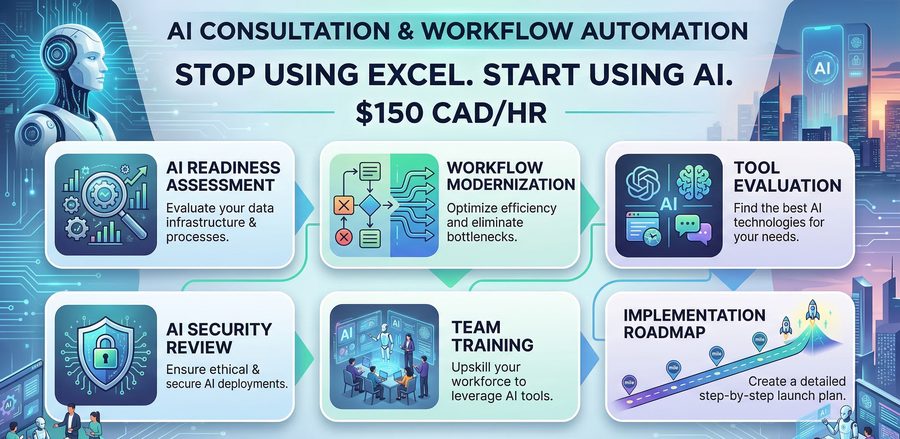
Plenty of people can build an AI workflow. Far fewer can explain what it will actually do for your business in numbers you can defend six months later. That gap is what this article is about.
Here is how to filter for the consultants who understand business ROI, not just technical ROI.
The ROI conversation they have before the technical one
A consultant who starts with architecture diagrams is selling you a build. A consultant who starts with your unit economics is selling you an outcome. Those are different services, and you want the second one.
In the first hour of conversation, a business-literate consultant should ask:
- What is your current revenue and how is it composed?
- What is the cost of the process we are talking about automating - in real dollars per month?
- If this worked, what would change for you? More revenue, lower cost, or unlocked capacity?
- What is the payback period that would make this a no-brainer for you?
If they never ask any of that, they are not planning to measure themselves against business outcomes. They are planning to deliver a build.
They quantify their claims
Phrases a consultant should be comfortable putting numbers behind:
- "This will save your ops person about 12 hours per week based on the volume you described."
- "At your transaction volume, the AI layer should pay for itself in about 4 months."
- "The LLM calls will cost roughly $180 per month at your usage - here is the math."
A consultant who cannot estimate these numbers out loud has not thought through the economics. They may still build a working system, but you will have no way to tell whether it is worth keeping.
They show you the risks, not just the upside
The most useful part of a good consulting conversation is the part where they tell you this will not work - and why.
Ask: "What could go wrong here? What would I regret in 12 months?" A real operator has ready answers: data quality drift, model cost increases, integration failure, team adoption resistance, vendor lock-in. Someone who handwaves these is optimizing for the sale, not the outcome.
Their references answer the economics question
When asking for references, skip "did you enjoy working with them?" - everyone answers yes to that. Ask instead:
- "Did this project hit the ROI target they proposed?"
- "What did you end up measuring to prove it worked?"
- "Would you hire them again at the same price?"
The quality of the consultant's references - specifically, whether those references can answer quantitative questions - is a strong signal. A reference who says "I think it helped, but I do not really know the numbers" means the project was never set up to prove itself.
They reject projects they cannot win
A consultant who turns down work is rare and valuable. Listen for statements like:
- "For this volume, you are better off with an off-the-shelf tool. I do not need to build this."
- "Your data is not ready for this yet. We need a cleanup phase first, or we should skip this for now."
- "This would work but the payback is 18 months. I would pick a faster project."
Consultants who do this have a practice that screens for high-ROI work. They can afford to turn down bad fits because they have enough good ones.
Their proposals are business documents
Good AI proposals read like mini business plans, not spec docs. They include:
- The business problem in one paragraph (in your language, not theirs)
- The proposed approach - two or three sentences, not architecture diagrams
- The expected ROI with math shown
- The risks and how they are mitigated
- The timeline and price
- What you own at the end
If the proposal is 20 pages of capability statements and case studies with no specific mention of your situation, the consultant is recycling. You want a proposal that was clearly written for your business.
The short version
A reliable AI consultant talks in dollars before they talk in models. They quantify, they acknowledge risk, they turn down bad-fit work, and their proposals are legible to a non-technical business owner. The ones who do all four are rare, but they are the ones worth paying for.