Why Productizing Your Service into SaaS Compounds Revenue
Most service businesses hit a ceiling when revenue tracks hours worked. AI now makes it cheap enough for small teams to escape that ceiling by productizing the repeatable parts of the work.
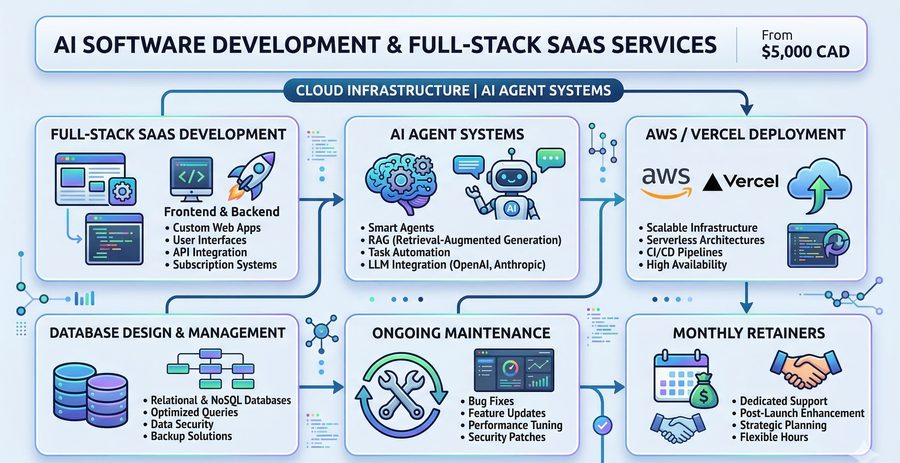
A pattern I keep seeing: a service business hits a ceiling. They are fully booked, prices are already at the top of the local market, and the only way to grow is to hire - which brings its own margin compression, training debt, and quality risk. The founder looks up one day and realizes revenue is capped by how many hours their team can bill.
Most "we need AI" conversations I have actually start here. The founder thinks they need a chatbot or a smarter CRM. What they usually need is to turn a service into a product - and AI is what makes that economically feasible for small teams now.
The math of productization
A service business scales linearly. Every new dollar of revenue requires roughly one more hour of human time. A SaaS business scales differently: one build, reused indefinitely, with marginal cost close to zero per additional customer.
The gap between those two curves is where most of the value lives. Consider a typical engagement profile I see across small firms:
- A bookkeeping practice charging $150/hour on retainer, capped around $20,000/month
- A law firm charging $300/hour, capped by partner availability
- A consultant whose revenue flatlines because they are already booked six months out
In each case, the founder has already built up intellectual property - a proprietary intake process, a triage workflow, a signature deliverable. They just happen to deliver it by hand. AI lowers the cost of encoding that process into software a customer can self-serve.
What changes when you productize
Three things shift at once. None of them is about "AI features." They are about business-model economics.
1. Revenue decouples from hours
A $300/month subscription with 200 users throws off $60,000 monthly without anyone working another hour. The same firm billing hourly would need 200 additional client hours to get there - which it physically cannot deliver.
2. Onboarding stops being a bottleneck
In service businesses I look at, onboarding is usually 2–5 days of partner time per new client. That is the real ceiling. Self-serve onboarding compresses that to minutes and lets the business grow through marketing, not hiring.
3. Churn replaces sales
Instead of constantly selling to new clients, you are keeping existing ones. That means product investment pays back over the customer lifetime, and every retention improvement is revenue you earned by not losing.
Most service businesses that productize successfully do not become SaaS companies. They become service businesses with a SaaS profit centre attached.
What AI actually does in the stack
The AI layer is narrower than most founders think. It does not replace the business logic, the UX, the billing, or the compliance work. What it does well in these builds:
- Intake and triage - extracting structured fields from unstructured client submissions (emails, PDFs, phone transcripts)
- Templated drafting - producing first drafts of contracts, reports, summaries, proposals at a quality a human reviewer can polish in minutes
- Classification and routing - deciding which specialist, which priority, which workflow
- Quality checks - flagging unusual cases for human review before they reach the client
Everything else - the database, the auth, the Stripe integration, the admin dashboard - is normal software that would exist whether or not AI was involved.
How long this typically takes
From a cold start, a focused productization build sits between 3 and 4 months for the first deployable version. That assumes the founder already has a clear service to productize and is willing to ship a narrow v1 rather than a feature-complete platform. The timeline expands quickly when scope includes multi-tenant billing, compliance (PIPEDA, SOC 2, HIPAA), or white-labelling.
When it makes sense - and when it does not
It makes sense when the service is repetitive with variation: every engagement follows a similar shape, but the details differ. Bookkeeping, contract review, appointment scheduling, lead qualification, document intake, reporting. It does not make sense for pure bespoke work - architecture, therapy, creative direction - where the value is in the per-case judgment, not the repeatable process.
A useful gut check: can you describe how you deliver this in a step-by-step checklist? If the answer is yes, and you could hand that checklist to a well-trained new hire, you can probably encode it into software. AI handles the steps that previously required human interpretation.
The first version is smaller than you think
Most productization failures I have seen come from trying to replace the entire service on day one. The builds that succeed usually do the opposite - they automate the single most repetitive step first, prove the economics, then expand the scope. A one-feature SaaS with 50 paying users is a better starting point than a five-feature platform with zero.
If you are service-bound and revenue-capped, productization is usually the lever. AI is what makes it cheap enough to try.